Ralf Baecker

“Chaos is not completely random, rather, it’s a complex arrangement of choreographed order that’s articulated through different activation levels.”
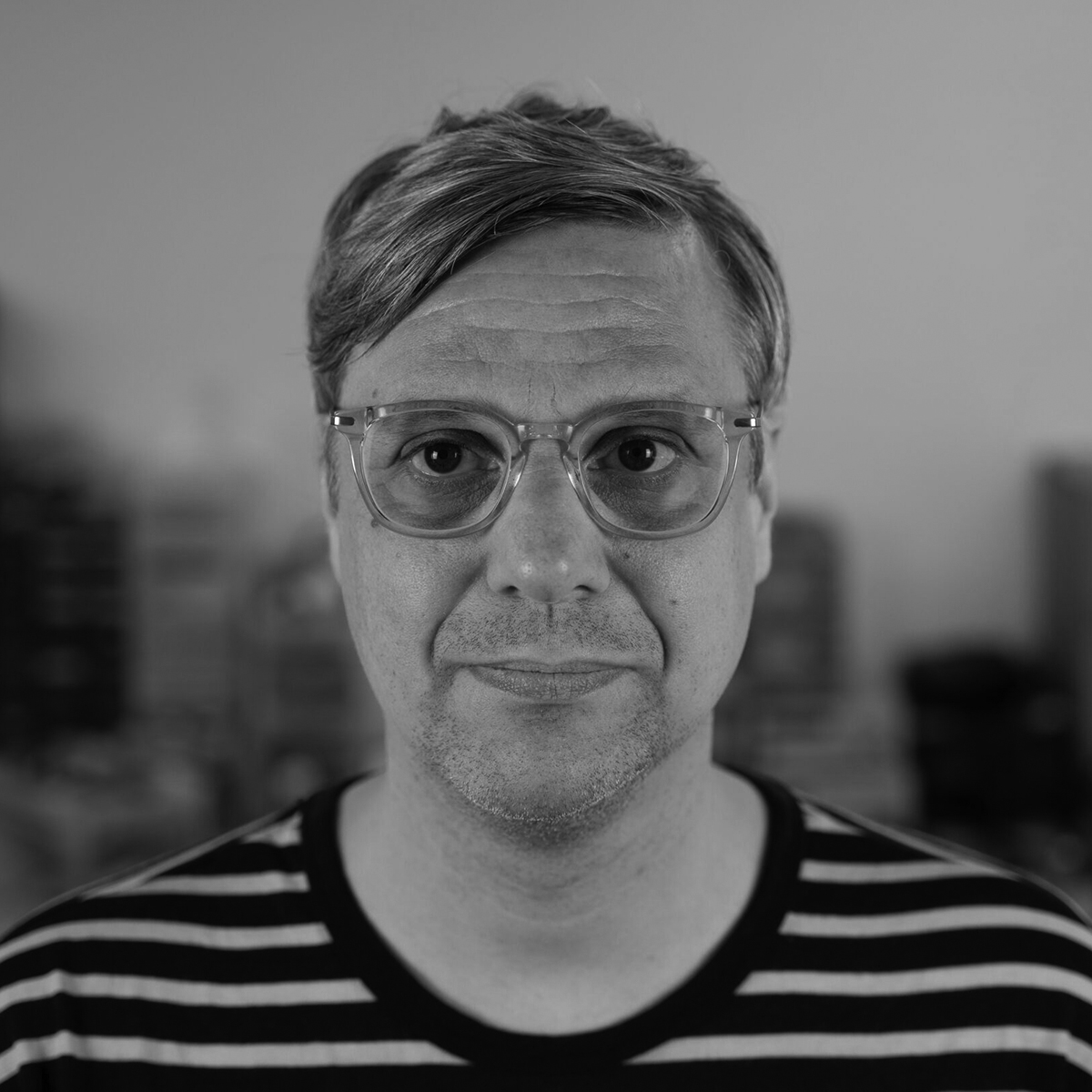
Ralf Baecker is a German artist working at the interface of art, science, and technology. Through installations, autonomous machines, and performances, he explores the underlying mechanisms of new media and technology. His objects perform physical realizations of thought experiments that act as subjective epistemological objects, posing fundamental questions about digital technology and complex systems and their sociopolitical entanglements. His projects provoke new imaginaries of the machinic, the artificial, and the real. His practice is a radical form of engineering that bridges traditionally discrete machine thinking with alternative technological perspectives and a new understanding of self-organizing principles.

Ralf Baecker: I went through your curatorial text, David. It’s a nice wrap up of the field, and addresses a lot of questions, topics, and concepts that are important to me.

David Familian: I have one question, just to start with. To see if it’s the same in Europe, the discrepancy, the separation between the sort of the humanities approach to cybernetics and their interest in cybernetics, and that discipline-based scientists are not even aware of cybernetics, or they think it’s old history.

Ralf Baecker: I think it’s probably the same. The last scientific institutes that were called cybernetics also vanished or died in the ’70s, must be around that time. It somehow became a part of engineering, not a systems engineering, but more like, feedback driven control systems, which is a very applied understanding of cybernetics without its system or philosophical or worldview implications that we might have, right? And I heard about cybernetics as a term when I started to study at the art school, before I studied at a computer science program, so cybernetics was not a term used, you know, it was more like, for me in the beginning, it was a very esoteric science, from the 60s, 40s, ’50s. So I got into it like in the early 2000s, from a professor who was teaching, you know, programming and technology in context of an art school.

David Familian: I mean, for me, I started by looking at the science. And then, when I got Yuk Hui’s book, Cybernetics for the 21st Century (2024), which initially just made me interested in the term recursivity and contingency. When I showed computational based media, like images generated in the ’70s, computational drawing, and poetry, but then when I started reading it, there’s all the cybernetics, and I remembered all Katherine Hayle’s mention of it, and when she gave her talk in Yuk Hui’s conference on cybernetics in the 21st century, she said there’s one school remaining, it’s in Australia, that’s actually called cybernetics.

And also, to me, cybernetics was the first sort of transdisciplinary idea, and it spun out, like you said, all these departments, you know, all these different disciplines in computer science and engineering, and no one really knew about the biological stuff, unless you knew the British people, which didn’t get as much publicity.

Ralf Baecker: We were big fans of like this biological computer lab that was run by Heinz von Foerster, this Austrian guy. And also then the British school like Gordon Pask and Ashby and so on, and Stafford Beer, so these were kind of also interesting figures, like this is second order or cybernetics thinking where it went beyond building war machines or optimizing.

David Familian: Yeah, it was all machine operations, and then Roy Ascott was the kid, probably, amongst all those people when he was in art school. I’m giving a paper at the American Society of Cybernetics in June, and that’s one of my points I’m going to bring up, is how we can reach out more to the scientists. I expect there’ll be scientists at this. So it’s going to be an interesting conversation because you’ll have scientists say, “no, we understand cybernetics.”

So the first question is about the idea of uncertainty. I’ve also just become aware of this guy, Donald Schön, another ’70s person who wrote a book, Beyond the Stable State, and he talks about that uncertainty as a time where there is no science; we have to discover the science, so it goes beyond Kuhn, but on the other end, it’s like, the uncertainty when you look at your piece. Or aspects of your piece that are uncertain.

Ralf Baecker: I started working a lot with software inside closed computational spaces, and I was looking for kind of connecting algorithmic systems to the world basically, and to add this uncertainty to my artworks, right. And sure, there’s a way of sampling the uncertainty of events that are unpredictable, and feeding them into the machine. So that was one approach. But then it was also a way of finding a radical openness towards building machines. So not building up on available computers, and to build my own universe of computational machines, and to design them very open and in a way where the openness is sensitive to its environment, and also the terms uncertainty and unpredictability, they are very close, at least from my perspective, and it’s sometimes hard to distinguish them. And how do you see that? What would be your take?

“I was looking for connecting algorithmic systems to the world, and to add this uncertainty to my artworks. It was a way of finding a radical openness towards building machines—to design them in a way where the openness is sensitive to its environment.”

David Familian: Well, the first thing I like, that I know a lot of people are talking about more now than they did when you probably started, is bringing in randomness from the outside world, not generating it by what’s built into a computer. That seemed to be what you were saying. It’s sort of Jens Hauser’s idea of the intersection between wet and dry is when you bring some of the wet into the dry, or Roy’s idea of moist media. I think uncertainty is a little more poetic than unpredictability.

I also think it carries a deeper, like Schön, when he’s using the word uncertainty instead of unpredictability and saying, in society, when there’s uncertainty, it’s a societal character, you think of people being uncertain, whereas a computer is unpredictable, or nature is unpredictable. Yes, we’re unpredictable too, but it’s a feeling that goes back to the original idea of the show. When I talk to the artists that we commission works, and when I was picking artists, I said that I want the visceral feeling of order and disorder to be in the works, and that provokes uncertainty in a human being. So to me, it’s a more human characterization. A computer can’t be uncertain.

Ralf Baecker: But the uncertainty is like a more complete understanding. With predictability, there’s already, maybe a path or different paths indicated. It’s not as radical as uncertainty, which, you know, can be more dramatically open.

David Familian: Yeah, and then you have the whole issue with probability built into unpredictability, that the way we understand unpredictability, is by sampling and making bell curves and all kinds of representations of that unpredictability to make it more understandable.

Gabe [Gabriel Tolson, curatorial assistant] is asking how does uncertainty begin, and Schön is basically saying, and I think it’s my point too, is we can no longer look at the world as certain. We are unable anymore to create a sort of homeostatic illusion that science was able to do really since Newton, I guess you could say. You know, a science without entropy—another definition of Newton which I’d never heard. The problem with Newton is he doesn’t account for entropy in his predictions. The planets have a four-million-year unpredictable window. All systems are predictable within certain timeframes. I’m curious if you agree.

Ralf Baecker: Yeah. I mean, there are very obvious examples now, like that we push our climate system closer and closer to its tipping points. What will happen if the Gulf stream breaks down? It’s really uncertain, what’s going to happen after that. A lot of people have a really hard time thinking about what a tipping point is, or how a complex system will turn into something else and what dramatic change this can have on specific areas on planet Earth.

David Familian: I’d really like to figure out a different term. The minute you say complex systems, people sort of glaze over when you try to explain it. And then in the popular culture, what happens is they’ll be talking about the weather or social media and say, “well, it’s very complex.” But they never talk about the underlying structure of what that actually means. Bruno Latour said, we’ve made global warming such a big issue, it’s so overwhelming, we feel powerless anyways, so we don’t even know what to do, you know, even if you drive an electric car, it has its own pollutants. Everything has something. I think we agree that we can’t avoid complexity anymore. The next question was about emergence, and new patterns of behaviors, and how you see that in general and how it appears in your work.

Ralf Baecker: Because there is no randomness in the machine or computational randomness, I started to use Geiger counters, these tubes that detect particles that create an event, which is totally uncertain. It’s unpredictable what’s going to happen, and I use this as a source for entropy that I feed into the system. The idea, which directs into the concept of self-organization, is that I drive the system with noise, with randomness, and I use the noise as a catalyst in order to create emergent structures. This was informed by, on one side, Heinz von Foerster’s concept of self-organization, where he proposes, ‘okay, make a little box, put little cubes in with magnetic surfaces, and shake the whole thing, and through that, certain crystal-like structures emerge.’

And this was the starting point: building a system that has structure, that has loose couplings between different agents, and then feeding it with randomness and seeing how specific patterns emerged. As an artist, designing emergent systems is almost impossible, since emergent systems result from something that happens by chance or that are there in nature or in the world, and that exist without a designer that has designed an emergent system. And this was a closed feedback process. I’m trying to enable the system to form structures, and then changing parameters. And so it became an impossible task of creating an emergent system through a design approach, or an engineering approach.

For me, emergence is super interesting. I approach it a lot in my practice. But it’s kind of a paradox, a little bit, designing emergent systems, because they are usually the result of long, long time scales, and long time scales that are not designed, that are just there.

David Familian: Right, but your piece isn’t affecting the Geiger counter. True emergence is an interaction. Emergence usually forms within a system that’s feeding back and forth. So if somehow your sculpture influenced the Geiger counter, then you may have true emergence.

Whenever I have an artist that says they’re using generative algorithms, I always ask first, what’s your fitness? And some of them look at me like I’m crazy, and then I go, is it just the system that is using the algorithm, or is the algorithm affected by something outside of itself, because that’s how emergence occurs. So I agree with you that if there was a way for your piece to influence the Geiger counter or the source of the randomness, you probably would get something more akin, but that takes a long time.

Ralf Baecker: But the emergence happens on a different scale. The basic construction of the work is that there are two opposite motors that pull against each other. And I have 190 of them, and they’re pulling each other like a tug of war. One is on, and then other one is off.

Each cord is connected to its neighbors through an elastic band. So there are certain moments where there’s a momentum where by chance, maybe two or three of them tend to go up, and there’s a momentum where the whole area of loose coupling creates this greater upwards movement. This is, for me, the emergent moment. And because the system itself probably can’t feedback on the Geiger counters because there’s no radioactive or heavy particles floating around, but there’s feedback between all the agents along the sculpture. They were influenced by the Geiger counter activity that adds another force, or sends another moment of activation into the system. And then there’s an ordering suddenly happening.

It’s like having sand on a plate with a speaker on it. And cymatic shapes form there through different levels of activation, which is also an emergent thing. You can’t foresee what’s going to happen if you set the thing in motion. And then you can only see what’s really happening if you turn the thing on, which is also sometimes in computers, you have the cellular automaton. If you look at the rule of the cellular automaton on one state, you don’t know what’s happening, but if you run it, you have this emergent behavior inside such a simple system as a one dimensional cellular automaton, like the Wolfram machine, for instance.

“Chaos is something that we have to embrace. We are deeply entangled particles in these complex systems. And we often try to get rid of noise, when it drives self-organization.”

David Familian: Right. We can’t individualize each molecule because the spins affect each other. And it can be local, and not throughout the whole liquid or whatever it is. The next question is the ultimate: would you agree that none of the vitality of any of these systems can exist without feedback?

Ralf Baecker: Yeah, and then there are many levels, right? There can be local feedbacks within system that starts to resonate in a way, or then in a larger scale, you have another feedback. In most cases, I think we talk about negative feedback, this feedback that creates stability, like the thermostat system, which is primarily used in the system. Small local feedbacks, and the balancing of the system, or that certain things, if they run over a set limit, and then decelerate certain parts and then drive it down and such.

I try to translate an engineering or a technological language into a poetic language, and turn it into performative complex systems. Feedback is the core of that language, the smallest unit of the system. It’s microscopic and it exists in digital measuring and controlled circuits and so on and in the mechanical and, and, and so on.

David Familian: In one of my readings, one of the economists began to look at economics as a complex system, and he brought positive feedback into his system. And he said that a good example of positive feedback is computer technology, and how positive feedback has made it change and grow, and it has not followed the traditional life-death cycle of traditional technologies within the economics, and he would have fights with his colleagues that they would argue there is no positive feedback. And also, one of the things you said, was that there’s also regulatory feedback, which I learned relatively recently that has a very discrete purpose like, hormones in our bodies, that control one hormone based on what input they get.

So you’re right. I agree. Feedback happens at all different scales. And it’s not something you can isolate, because these many registers all feed off each other. You can look at them as being isolated, but ultimately there’s a dynamics between them.

Ralf Baecker: That was also the problems of first order cybernetics: you, as a scientist or observer, were already influencing the system, and then the second order was kind of inserting yourself as an observer in the system. By looking at it, by conducting it and interacting with your experiments, you are already changing it.

David Familian: And then finally, another element that’s part of the vitality of complex systems is the element of chaos. It’s another term that gets misunderstood, because people think of biblical chaos, which isn’t what this is. What’s interesting about the term self-organization is that Ashby didn’t like that term. He wanted to call it contingent, and I think it’s interesting that that word has popped up now as a term that may be replacing self-organization in some way that, but he immediately, he felt it didn’t reflect the rules behind self-organization.

Ralf Baecker: Yeah, but you used to actually build this as a homeostat, like the self-stabilizing system. And he was, interestingly, in a dispute with Turing at that time. Turing was like, ‘We build the universal machine that solves all problems.’ And Ashby was like, ‘Oh, we built this one, this dedicated machine,’ and so on.

Chaos is highly ordered, in a way. People think it’s just noise or disruption. But chaos itself is like an odd structure that somehow changes its way of expressing itself at different levels of excitement or energy. Like water that runs down the river, it builds waves behind it. And then if the energy is increased the wave might turn into something flat suddenly, and then more energy, and then suddenly they build another complex wave in the river. It’s not completely random, rather, it’s a complex arrangement of choreographed order that’s articulated through different activation levels.

David Familian: Well, it still has a pattern. There’s a record, especially with water. It’s chaotic, but you see patterns, you see structure. It’s interesting how all these terms, whether it’s complex systems or chaos, really, confuse people in a lot of ways. And that’s one of my things about the show, and about my writing in general: how do we make this all understandable in a way that doesn’t sound like we’re explaining a scientific concept? Because it’s actually a very poetic process, and it’s about life.

Ralf Baecker: Chaos is more something that we have to embrace. We are deeply entangled particles in these complex systems. And there’s chaos, and there’s noise. And we often try to get rid of noise. We try to get rid of the disruption in the system, but they are often also in connection to processes of self-organization.

They are the thing that make it. You have to push the system, or something in it, in order for it to unfold, and restructure and build. Like birds flocking around, and some little irritation suddenly makes them move into a different direction. One unconscious movement of one of the birds, and suddenly the whole flock, goes into a new direction very beautifully. This is the beauty of noise, or chaos: it creates change that can be applied in a cultural or a political way.

“You have to push the system in order for it to unfold new behaviors. Like birds flocking around, and some little irritation suddenly makes them move into a different direction.”

David Familian: Well, I think what’s interesting, is that repressive governments try to control the chaos and get rid of that voice in society. That’s what they propose. And become seductive to a certain portion of the population that both, your country [Germany] is feeling and we’re feeling also is this wanting to get rid of the chaos and uncertainty. The question will be, by China retrenching back into a more repressive culture, will it lose something that it gained through expansion of a hybrid capitalist-communist model? It’s going to be interesting, because it definitely didn’t work for Russia.

You hear people all the time say can’t we get rid of some of the chaos in our society—but chaos is the thing that’s good about society!

Ralf Baecker: And I understand that people are kind of struggling with it. Sometimes I’m teaching in art school. Sometimes I want all control: let’s do things super structured. And then students bring in disruption, and things happen, and we kind of end up somewhere else completely. And that’s something to embrace. This can happen in all parts of science and society. It’s hard to gain new ideas, concepts and perspectives in a very harsh, or in a very controlled and repressive society. It needs space for radical change.

David Familian: I mean, it’s going to be interesting, with all that’s going on in the academic world in China. Will that become a threat to the government, these kinds of ideas, or will someone suddenly say, ‘look what’s going on. Something’s not happening that was happening 20 years ago.‘ I think the difference between China and Russia is China actually produces things that the world wants. Whereas Russia never produced anything the world wanted, really.

Ralf Baecker: Yeah, but they produced so many beautiful things, like a trinary computer.

David Familian: A certain amount of chaos is allowed in science that they don’t let exist anywhere else. Where chaos is allowed, things do happen.

We’ve talked about real world complex systems in our conversation. When you perform, or when you see people view your work, do you find that they come away with a different sense of uncertainty? Or do you, think you’re speaking to the converted, usually that already understand.

Ralf Baecker: I think so. There are moments of insight, and I have this experience often, that people spend lots of time there and get intrigued by it, or start to interpret things and make connections to the world. And I think this is due to its structure, or how it articulates itself through this noisy soundscape and this contrast between super high oscillations in the machine and the small movements of people. People are triggered, and their brains start to make connections. I like when people start to interpret and to make their own story. You can go super close into the details, look at one or two individual things and maybe understand something, and then you go back and you see the whole landscape changing in two different scales of the same process, through this openness of the machine.

I call it performative complexity. When people deal with complex systems, they are, because of the timescales, often just confronted with one state of it, but which has a long history to get there. The idea is to have different states, to look into. Something that looks steady and stable, but that has this vibrance on the other side that illustrates the process, that indicates the many thousands of little steps that formed this thing. This is what I want. On one side, offering specific things that people can understand, but also kind of being a little bit puzzled by what’s happening. To keep people in between these two states of understanding.

“I call it performative complexity. Something that looks steady and stable, but that has this vibrance on the other side that illustrates the process. This is what I want. To keep people in between these two states of understanding.”

David Familian: Barry Richmond, who originated systems thinking, wrote that we must see both the forest and the trees, and that’s what I think your work does. Instead of that sort of thing where you look at a cube and see it from one angle or the other or some optical illusion, there’s more simultaneity between the forest and the trees when you look at this work, especially because it can happen so fast that the processes get blurred together, depending on how you’re looking at it.

The next question is, what’s the visceral experience? What I think it is with your piece is going back and forth, as if you looked at a forest and the trees, but you saw the trees growing and sped it up, so you can see the forest as a living thing. And I mean, the trees are alive. And then the whole forest. That’s sort of what your piece does. It speeds feedback up. Like you said, there’s not a delay between the affect and effect.

Gabriel Tolson: We’d love to know how you came to emotionally connect with complexity and systems thinking.

Ralf Baecker: It’s hard to say. In my art school, there was a Professor who invited one of these early chaos theorists, Otto Rössler, who came up with this concept of attractors and I heard a lecture from him about chaotic systems. I think that was in the middle of the 2000s, like 2005, when the term chaos theory was still a thing, and now it’s been replaced by complexity theory, or complexity research, in order to get rid of this esoteric notion of the term. That’s when I came across it. It was primarily like attractors or building electronic circuits that perform these complex attractors.

David Familian: I think that’s interesting because we all heard of chaos before complex systems because of James Gleick’s book, Chaos: Making a New Science (1987). People think chaos is this separate thing. It’s whether they conflated complex systems with chaos, or they thought chaos was its own thing, and it’s part of something. Everything’s part of something. That’s sort of the problem. Gleick made chaos its own thing. It’s only a small part but it’s not necessarily even the most important of complexity. Feedback to me is more important. There is no chaos without feedback. The cascading effects of feedback creates some of the chaos. They came up with all these wonderful terms to visualize chaos that made it understandable, but actually it just confuses, it doesn’t really help.

Ralf Baecker: One example that always comes up with chaos is this double pendulum, where small changes in the starting parameters will create completely new, different behavior.

David Familian: Scientists don’t use chaos. They say deterministic chaos, because it’s not truly random or unpredictable. And once you started going, if you have the right formula, it will follow that track. It’s just the initial conditions. The initial conditions are unpredictable, but once it starts, the system becomes predictable.

Ralf Baecker: Where my interest started was probably through the cybernetic perspective, and also through modeling these things digitally, you know, writing all the classical algorithms. So looking at cellular automatons, building, programming flocking algorithms and chaotic attractors, or programming a double pendulum. All these things where you, try to find the unpredictability in the machine, exploring the seemingly infinite possibilities of the computational space. And that was kind of a thing that I did in 2003. I did a lot of things with visuals and generative artworks. And then the translation from the computational closed Turing space into physical sculptural objects, I think that was for me the important step to go out of the computational space. I’m not interested in the images that the machine produces. I’m interested in what’s happening inside the black box of the machine.

That was for me the important step in my artistic practice. And then the performativity of what is inside the machine. Because there was like, there was software art and computer-based art. Software art could be super conceptual, but you always are confronted with the output of the system. The most radical form of software is showing a computer running software without a screen, just running inside the machine. And from that thinking, I came across like this. I’m building on my own computer, but I built it really badly. And in a way, that it opens up space for uncertainty, you know, and, like with the kinetic art of the ’60s, like Jean Tinguely, who said, “I take the machines from their slavery in the industry, and put them into an artistic context.” And this was also to take them from their terrible jobs in finance and offices and free them.

David Familian: Were people you went to school with at the time looking at things? Was it sort of divided between who wanted to make more physical systems and who was making computer-based artwork? I’m thinking about Simon Penny, who teaches at Irvine, and he was making art that probably had an influence in your generation.

Ralf Baecker: I studied at the Academy for Media Arts in Cologne, and there was a group who kind of did that, like going from the, from the digital into the physical realm. Also in Berlin, Joachim Sauter and Art+Com had a new media class at the University of the Arts in Berlin, and they also started trying out things like this, but in a very controlled way, so they often went like, ‘Let’s take a digital signal and add it to the motor and build a three dimensional thing that represents something in the digital space.’ I don’t know, having two hundred little spheres moving up and down to create something that looks like a car, right? Taking the digital pixel into the physical pixel.

David Familian: I think this is an interesting point, this shift that some people made, because I think about my own understanding of the history of digital media, and, I don’t think until I started looking at complex systems, did I start to see there’s another whole approach here.

But some of it had to do with working with Jens Hauser on a bio art exhibition, even though we had this sort of tension because I was showing dry art. In his sort of condescending way, he made me aware of that. But then I think, going to complex systems and seeing that there’s this whole thing that opened up that I’m noticing now that I don’t think I noticed when I was looking, say, at, computational work from the ’70s, or Vera Molnar, or generative word based work, that is sort of what you’re saying.

It’s still that it creates unique outputs, but it’s not what we’re talking about. And that divide is an interesting thing when you go beyond just physical computing. But I think the term is—you go from physical computing to performative computing. And the people doing physical computing think it’s performative. But it really isn’t.

Ralf Baecker: Usually, you have a black box, which is computing, and then you send the stuff to whatever is out there.

David Familian: But they think it’s a performance. They think because it’s performing, but it’s not really.

Ralf Baecker: It’s only one directional. My idea is to create interactions in the material itself.

David Familian: Well, I think that’s a perfect ending. I think we got it. That’s really good.
Ralf Baecker, Interface I, 2016

Katherine Hayles

“What really struck me was the equal playing field on which robots, microorganisms, non-human species and humans appear, all woven together in a complex ecology.”

N. Katherine Hayles (born 1943) is an American scholar known for her interdisciplinary work linking literature, science, and technology, particularly in the fields of posthumanism and electronic literature. A former chemist, she became a distinguished professor, pioneering analysis of how digital media reshapes human identity and cognition, notably in foundational texts like How We Became Posthuman. Her work explores contemporary fiction, cybernetics, AI, and the cognitive nonconscious, making her a key figure in digital humanities and science/tech studies.

David Familian and Professor N. Katherine Hayles, scholars aligned in their art-science interests, met at UC Irvine in August 2024 to discuss the exhibition Future Tense: Art, Complexity, and Uncertainty, which was then running at the Beall Center for Art + Technology at UC Irvine from August 2024 through January 2025. They used this opportunity to further explore Hayles’s work relating to chaos and complexity, as well as her early observations of cybernetics.

David Familian: Can you talk a little about your background and your interest in chaos and complexity in your research?

Katherine Hayles: I started my professional career in the sciences as a chemist. I did my undergraduate work in chemistry and then got a master’s degree in the field, and only then did I start the serious study of literature and culture. What I acquired during my scientific training were the basic mathematical tools to understand the world of science. I was really interested in how ideas circulate between the humanistic and scientific communities. At the time that I started my research into quantum field theory, there were a lot of influence studies–the influence of Newton on Alexander Pope and so forth–but it seemed to me that there existed much richer connections. My first book, The Cosmic Web: Scientific Field Models and Literary Strategies in the 20th Century (1984), was an attempt to begin to develop a theory in which one could talk about those interconnections. My second book, Chaos Bound: Orderly Disorder in Contemporary Literature and Science (1990), was a case study of how that actually works in practice. So, my interest in chaos goes back to the 1980s and 1990s. Chaos science seemed to me a marvellously fertile paradigm. When it matured into complexity theory, it was able to explain and investigate a huge range of phenomena, which is on display in this show.

David Familian: One of the things about your Chaos book that I remember is when you were writing about Mandelbrot, you talked about how his contemporaries were making fun of his work, as if it were too feminine or intuitive. How could a scientist not be curious, or not have intuition?

Katherine Hayles: Or, how could a scientist not be human, and have all of the insights and frailties of humans?

David Familian: It’s fascinating how you went from the sciences to the humanities. I’m reading a book now which mentions Heidegger saying that philosophy is not the handmaiden of science. But then, thirty years later, he gave that lecture where he said that cybernetics is the new metaphysics. And in your book, How We Became Posthuman (1999), you go back to the origins of cybernetics, if I remember correctly. 

Katherine Hayles: I went back to the Macy Conferences [on Cybernetics, held in New York from 1946 to 1953]1 and did a close reading of several of their annual conferences. But I was really interested in some fundamental questions, one of which was how information lost its body. And I was also interested in the emergence of this new vision of what the human was, a notion I labelled as the Posthuman, which was rapidly subverting and rearranging traditional ideas from the Enlightenment, like free will, the autonomous self, and so forth, and cybernetics had a role to play in that. It’s kind of a conundrum that even as cybernetic ideas diffused into culture generally, cybernetics as an academic discipline virtually disappeared. Cybernetic ideas were taken up and became central in any number of fields, but not in themselves as a coherent discipline.

“It’s a conundrum that even as cybernetic ideas diffused into culture generally, cybernetics as an academic discipline virtually disappeared.”

David Familian: What’s interesting in the Steve Strogatz book I’m reading, Sync (2003), is that he mentions cybernetics and claims, falsely, that we don’t practice cybernetics anymore, yet his whole book is about ideas that came out of cybernetics. The way I look at it is that cybernetics is a methodology, not necessarily a science. It’s a way of looking at our world. Maybe the idea, as Wittgenstein says, is that we don’t think up language; we only pick it up socially. It’s the feedback between us that makes us human; it’s not all internal.

Katherine Hayles: Absolutely. Some of the ideas of cybernetics are being resurrected in other contexts, for example, one of the important papers that Norbert Wiener co-wrote was called “Behavior, Purpose and Teleology.” Their argument was that cybernetics leads to teleological conclusions, because the whole idea of goal-seeking behavior was one of the fundamentals of their early robotic installations. More recently, Michael Levin at Tufts University has picked up that argument about teleological behavior in the context of microorganisms, bacteria, and such, arguing that the only way to understand these microscopic forms of behavior is as a desire to continue their existence. He collaborated on an essay with Daniel Dennett called “Agents with Agendas.” Their argument basically is “if you don’t understand the agenda, you can’t understand the behavior,” which is precisely the argument that Weiner was making in the 1950s. So these arguments get resurrected. Now, of course, Levin is talking about microorganisms, not about robotics, but I think there’s a deep connection there. 

David Familian: Can you define teleological?

Katherine Hayles: Teleological means behavior directed toward some goal, and that the goal is preset and defined, that the goal dictates the behavior rather than the behavior dictating the end result.

David Familian: And then the goal changes because you have to adapt to new environments. So the environment then becomes a trigger.

Katherine Hayles: Absolutely. There’s a fascinating recent paper out by Stewart Kauffman, a theoretical biologist, and Guiseppo Longo, a French mathematician, and they’re basically arguing that there’s a definitive divide between physical systems and living systems. The difference is precisely that living systems are teleological. Living systems want to continue their existence. And physical systems don’t want anything; things just happen, like a lake evaporating or a mountain eroding. There’s no agent there to give it a teleological impetus. But as soon as we get into the biological realm, those teleological impulses are everywhere. The progress of a physical system, even very complex ones with criticality points and so on, can be mapped into phase spaces showing how their trajectories will proceed.  With biological systems, no such tidy evolutionary trajectory is possible.

“Living systems are teleological. They want to continue their existence. Physical systems don’t want anything. There’s no agent there to give it a teleological impetus.”

Katherine Hayles: Kaufman and Longo give the example of the lungfish, a species which breathes air and water through both gills and lungs. They say that as water entered the fish’s lungs, the organ turned into a swim bladder and was used to regulate buoyancy. This created a new niche and opened the pathway for a new species—say a worm or a bacterium—to evolve that would exploit this development. That’s what Kaufman means by the adjacent possible.  Something opens a new opportunity adjacent to an existing opportunity, and now evolution can take on a new trajectory.

David Familian: In Gail Wight’s work in the show, Ostracod Rising (2024), global warming is affecting evolution in microorganisms and creating new adjacent possibilities for these species to evolve and enter new environments.  

Katherine Hayles: Maybe we can use that as a segue to talk about the exhibition. What really struck me about the show was the equal playing field on which robots, microorganisms, non-human species and humans appear, all woven together in a complex ecology. If you think in environmental terms, that’s exactly the way that complex systems work. It may start with symbiosis between two species, but then it begins to spread more and more. 

My new book, Bacteria to AI: Human Futures with our Nonhuman Symbionts (2025), tries to approach these complex interactions through the notion of cognition. Cognition was very carefully chosen because the human species considers itself to have superior cognitive powers to any other species, and that’s what accounts for our putative ability to dominate every other species on earth. But this new research, of the kind in which Michael Levin engages, is beginning to expand the notion of cognition beyond the human, into the nonhuman. These moves are inviting a radical reappraisal of what constitutes cognition. It inevitably feeds back to affect how we think about human cognition as well; instead of a simplistic idea of human superiority, now we have this much more complex and humbling view of human cognition as one form of cognition active with many other forms in complex ecosystems. I very much saw that on display in this exhibition, and it’s a wonderful way to approach complex systems and complexity in general. 

David Familian: One of the goals of this show was not just to have people intellectually process the idea of a complex system, which I think is very important to our survival, but to feel it. That’s what art allows us to do is to feel what this looks like, because our minds don’t work that way. We try to bring sequential order to our lives, but now, in order to understand the world, we have to change that. We have to see the world as a complex system, and our brains have to change to think in patterns rather than in cause and effect. We’re trapped in this linear thinking that has produced all this wonderful knowledge, but it’s almost useless for solving the wicked problems we face today. Responding to your comment, I specifically wanted the artworks included in Future Tense to engage multiple systems.

“We’re trapped in this linear thinking that has produced all this wonderful knowledge, but it’s almost useless for solving the wicked problems we face today.”

Katherine Hayles: Right, and at different scales as well, from the intercellular to the forest. I was really taken by Laura Splan’s work, Baroque Bodies (Sway) (2024). That was, to me, quite remarkable, both visually and conceptually. It showed this interplay between the environmental and genetic factors, and how they could work together to create a very complex system.

I was also extremely interested in Cesar & Lois’s sculptural display of the ecosystem in Being hyphaenated (2024), with the plants and the fungi collaborating to convey messages back and forth. I recently had occasion to read Suzanne Simard’s seminal paper on what would come to be called the “Wood Wide Web.”2 Her research was fundamental in showing the way fungi and root systems collaborate to carry messages and distribute nutrients, leading to a really complex symbiotic system. I thought the sculptural quality of that artwork made these interactions visually apparent and quite appealing. 

I’ll add one more element to this tapestry we’re weaving here, and that is Lynn Hershman Leeson’s piece, Logic Paralyzes the Heart (2022), on facial recognition and AI interpretations. I think if we’re going to re-envision cognition, crucial components of that are the cognitive abilities of computational media, including AI, algorithms, and so forth. We’re beginning to understand more fully how there is this deep interconnection between human cognition and the cognitive abilities of computational media, and to explore our ongoing symbiosis with computational media. Re-envisioning cognition, in my view, has to have a place not only for non-human life forms but also for non-human cognizers. 

David Familian: So it’s not just biological, it’s also computational.

Katherine Hayles: That’s right. I call this new framework to understand cognition the Integrated Cognitive Framework, the ICF. The “integrated part” of that phrase refers to emphasizing and exploring more fully the way in which feedback loops are operative throughout this system. From AI to human, from human to AI, from nonhuman life forms to human and back again.

David Familian: Feedback is the engine; it’s what keeps the thing alive. In Roy Ascott’s idea of moistmedia, there is a constant exchange between the “dry” computation and “moist” nature. Maybe AI needs more than the inputs we provide based on what we want to get out of it, but something else that comes from the environment or other sources.

Katherine Hayles: Imagine an AI that could choose its data training set. What if it really wants the data from a forest in England, for example, rather than human-authored texts? That’s fascinating.

“Imagine an AI that could choose its data training set. What if it really wants the data from a forest in England, for example, rather than human-authored texts?”

Notes

  1. For more information and recordings documenting the Macy Conferences, see https://www.asc-cybernetics.org/foundations/.
  2. For more information, see: Sophie Yeo, “The ‘wood wide web’ theory charmed us all – but now it’s the subject of a bitter fight among scientists,” The Guardian, July 9, 2024.

Curator’s Introduction

by David Familian

Future Tense: Art, Complexity, and Uncertainty is an exhibition of contemporary artists whose work explores complex systems at the nexus of art and science. The word complex,  derived from the Latin plectere “to weave,” describes how interconnected, complex parts in each system are woven together, but also interact with other systems. One cannot think of them in isolation because they are constantly interacting with each other through feedback, generating chaos, emergent behavior, and self-organization, all of which create uncertainty. For instance, climate change, pandemics, social unrest, and geopolitical turmoil are all generated within complex interactions between elements that lead to unpredictable, dynamic outcomes. Another element in complex systems is that we can never have complete knowledge of every interaction of a given system. All systems become less predictable over time, producing tension and uncertainty, which explains the exhibition’s title. 

A Walk Through

Future Tense: Art, Complexity, and Uncertainty includes interdisciplinary works of art that represent, demonstrate, and embody the fundamental nature of complex systems. The emerging and established artists selected for this exhibition focused on different aspects of complexity, using both traditional media and new technologies such as computer modeling, robotics, and dynamic AI-generated data visualizations. The works explored complex systems at various scales, from that of microscopic organisms to the totalizing implications of global warming on a planetary scale. The exhibition endeavored to help audiences understand how complexity functions within the individual works but also engaged them to actively experience the overarching aesthetics and effect of each system, which is reflected in the exhibition’s installation.    

The exhibition is arranged thematically in three distinct galleries, each with a different ambience aimed to produce a disparate effect. The first gallery focuses on one characteristic of complex systems: chaos, where works demonstrate various chaotic elements or systems out of control. For instance, Clare Rojas’s Circle of Infinite Chaos (2022), a representational painting of a woman (possibly the artist) lying peacefully in a hollow below grade with objects buzzing above her reflecting chaos in her inner mind. The tension between both chaos and order is visible in several works: Julie Mehretu’s Landscape Allegories (2004), etchings of turbulence landscapes; Fernando Palma Rodriguez’s Huitzlampa (2023), kinetic sculptures programmed to respond to live weather in Los Angeles; and Ralf Baecker’s Interface I (2016), a kinetic sculpture of thin bands driven by signals from the ambient radiation of the earth, some that form smooth sine waves, others that move with frenetic energy. Carolina Caycedo and David de Rozas’s Measuring the Immeasurable (2022), a hanging installation of surveying tools and drawings of indigenous rock paintings, references how the Public Land Survey System (PLSS) created displacement and environmental chaos for native peoples and their land.  

The second gallery features three video projections in a dark, interstitial, liminal space where viewers could have a respite from the previous chaos. Laura Splan’s Baroque Bodies (Sway) (2022), an interactive video projection on a wall, zoomed in and out in response to the movement of participants moving in the space as they explored the impact of the environment on gene expression. Theresa Schubert’s Glacier Trilogy — Part 3: Simulating glacial water systems (2022) included two large flat-screen monitors stacked vertically, screening a real-time simulation of melting glacial ice that varied according to the amount of carbon dioxide in the room. David Rojas and Carolina Caycedo’s video, Teaching of the Hands (2020), a companion piece to Measuring the Immeasurable, oscillates between a documentary about the history of colonization with its ravaging extraction policies and a poetic meditation on indigenous knowledge and caretaking of their land.

The third gallery focuses on the complex and unknowable in both past histories and speculative futures. Gail Wight’s Ostracod Rising (2024), a timeline drawn like a 19th-century naturalist illustration, explores both previous and anticipated future extinctions of organisms on our planet. Chico MacMurtrie’s Dual Pneuma (2024) is a large installation of futuristic, soft robots whose movement is powered by air from pneumatic tubes. They are installed alongside ceramic “doubles” cast from the robots, which play sounds using the same water whistle technology as ancient Meso-American flutes. Pilar Yoldas’s Alphabet of Life (2024) are glass orbs etched with the molecular structures of twenty amino acids, the building blocks of life. Hege Tapio’s Ephemeral (2024) consists of a promotional video, didactic materials, and a prototype to imagine a fictitious corporation where venture capitalists embrace a brand new technology: hormonal implants to alter our emotions. Cesar and Lois’s Being hyphaenated (Ser hifanizado) (2024), a living sculpture and experiment with sensors, measures the complex communication between mycelium and other plants, with the data visualized on a computer. 

The final part of this exhibition in the fourth gallery features two artists who provide cautionary tales for the future: Lynn Hershman Leeson, one of the first media artists, and Newton Harrison, an innovator of environmental art. Lynn Hershman Leeson’s Logic Paralyzes the Heart (2022), a photo and video installation about AI-generated life forms, includes a character that reveals the historical secrets of past surveillance technology and potentially dystopic future technologies. Newton Harrison’s Epitaph (2022), his final work, is a drawing of an imagined tombstone for himself and his long-time collaborator, the late Helen Mayer Harrison. Referencing their dialogical artistic process, the text on the tablet-like tombstone is a conversation between Harrison and what he calls the “life web.” The penultimate line on the tombstone reads, “Human, Human to survive, learn from your companion species how to rejoin me,” which reflects Newton Harrison’s frequent admonition for humans to coexist with nature to prevent human extinction.

The overarching goal of Future Tense: Art, Complexity and Uncertainty was for audiences to understand how complexity functions in our everyday life through works of art. Audiences could see and experience (perhaps even feel) the dynamic interplay of chaos and order, uncertainty and unpredictability in extreme weather events and climate change, robotics and AI, and in biological systems in plants and within our own bodies, just to reiterate a few. Ultimately, the artists in Future Tense: Art, Complexity and Uncertainty propose ideas about this paradigm of complex systems that help us understand that while we cannot solve all these vexing global issues, we must learn to manage them, or our survival will continue to be at risk.

Historical and Curatorial Precedents

For the last twenty years, as a curator, I have had a long-standing interest in the concepts of chance and probability that control randomness and can generate uncertainty in art and science. At critical junctures, paradigmatic shifts occurred in art, philosophy and science that embraced randomness, indeterminacy, and unpredictability. In the visual arts, the modernist avant-garde redefined the very meaning, function, and materiality of art by welcoming chance in the production and reception of art.

A few voices in the late 19th century began to question the determinism of science and its goal of certainty. For instance, scientists, including physicist/mathematician James Clerk Maxwell and physicist/philosopher Ludwig Boltzmann, could only understand the kinetic behavior of the molecule through probability using statistical mechanics. In trying to solve the “Three-body problem” (why do three celestial objects, i.e. planets, stars, or suns with similar mass exert force on each other when they are in proximity?) physicist/mathematician Henri Poincaré realized even a minute miscalculation in the starting position of each body would give an inaccurate result, as the systems are so chaotic and unpredictable.1

This skepticism about certainty continues into the 20th century.  In his book Creative Evolution (1907), philosopher Henri Bergson argued that Darwinian mutation cannot be predictable, but must involve chance and uncertainty.2  As scientists looked further into the structure of atoms, they found bizarre behavior which led to the theory of quantum mechanics. In 1927, when Werner Heisenberg and Niels Bohr presented their “uncertainty principle,”3 positing that you cannot know both the speed and the position of a particle at the same time, they confronted much opposition because it depended on probability. Albert Einstein, who did not believe that nature is unpredictable, reacted to their principle, famously stating that: “god does not play with dice.”

Artist Marcel Duchamp became interested in the concept of uncertainty and read the writings of Henri Poincaré, including Science and Hypothesis (1903) and Esprit Jouffret’s book on the fourth dimension, a popularization of Poincaré’s book that was read by many artists at that time.4  When most art historians think of Duchamp, it is in relation to his impact on the development of conceptual art, but equally important is how he dealt with uncertainty, indeterminacy, and chance. One may see this in his Three Standard Stoppages (1913-14), where three one-meter threads held horizontally were each dropped from a height of one meter onto a piece of canvas and fixed in position by means of varnish.5 His composition Erratum Musical (1913), a score for three voices composed by Duchamp and his two sisters, Yvonne and Magdeleine, both musicians, was created by randomly picking up a range of twenty-five notes from a hat.6

Artists responded to the rupture of World War I, also using chance along with found objects and nonsensical language in raucous performances at Hugo Ball’s Cabaret Voltaire in Zurich.7 This is where Richard Huelsenbeck reportedly slid a paper knife into a dictionary and randomly selected the word “Dada”—hobbyhorse in French—as the name for the group of artists. In the 1920s, surrealists embraced the unconscious and the irrational to reflect the extreme level of destruction, death, and trauma of war. Like the scientists and philosophers, Dada and surrealist artists also continued question certainty, predictability and rationality, which became the zeitgeist of the post-World War I era.

In the 1950s, John Cage developed “chance operations,” indeterminate procedures to make visual scores for compositions, often open-ended and including audience participation. Beginning with his famous Untitled Theatre Piece #1 (1952) at Black Mountain College, he developed these early intermedia performances combining painting, poetry, dance, music, everyday sounds and found objects. Influenced by Cage, Fluxus artists wrote their own “event scores “for brief, multi-sensory intermedia performances. For instance, La Monte Young’s “Composition 1960 #10,” also known as Draw A Straight Line and Follow It, was interpreted by Nam June Paik in his Zen for Head (1961) where he draws a straight line by dipping his head (or sometimes his tie) in ink and drags it along the paper, making what looks like a Zen ink brush scroll.

Complexity, Wicked Problems and Systems Thinking

When I first heard about Getty’s PST Art and Science Collide theme, I knew that it presented an opportunity to expand further upon the concepts of probability and uncertainty that I engaged with in previous Beall exhibitions.8 What I did not know was that this would result in four years of research into adaptive complex systems, their histories and methodologies. This started out with a deep dive into the literature of complexity theory that led me to cybernetics, Immanuel Kant’s philosophy of the organics, and eventually, to ubiquitous, adaptive complex systems all around us that affect our lives in very profound ways we cannot ignore. 

René Descartes described the old scientific method of problem-solving succinctly: “Divide each difficulty into as many parts as is feasible and necessary to resolve it.”9 In short, everything is like a clock: in that manner of thinking, one knows what every part does and can predict with certainty how it will operate. In contrast, Bruno Latour explains in a discussion about global warming: “The disorientation people feel regarding the planet, and the fact that they can’t react quickly to a situation that everyone knows is catastrophic, is largely because they continue to be in the world in the past, one where there are objects that have no agency and can be controlled by calculation and science.”10 Today, like Latour, we assume climate change consists of a set of complex, dynamic, interrelated systems that produce unpredictable outcomes that, unlike the “clockwork” paradigm, cannot be resolved by calculations or science.

Adaptive complex systems theory attempts to explain how large numbers of relatively simple entities organize themselves into a collective whole that creates a pattern, such as a group of flocking birds. While adaptive complex systems y more accurately reflect our current conditions, their complexities make them difficult to comprehend. In 1973, urban planners Horst W.J. Rittel and Milton M. Webber coined the phrase “wicked problems”: A wicked problem has innumerable causes, is tough to describe, and doesn’t have a right answer… Environmental degradation, terrorism, and poverty—these are classic examples of wicked problems. They’re the opposite of hard, but ordinary problems, which people can solve in a finite time by applying standard techniques. Not only do conventional processes fail to tackle wicked problems, but they may exacerbate situations by generating undesirable consequences.11

Twenty years later, Barry Richmond developed the idea of “systems thinking,” proposing a possible way to solve “wicked problems.”12 Richmond emphasizes how systems thinking observes complex systems bi-focally and that “one must see both the forest and the trees.”13 Systems thinkers strive to see both the generic and the specific, as well as shifting patterns in an event.14 Finally, Richmond noted that if one does not employ systems thinking and tries to change just one element of a complex problem, the chance of unintended consequences will increase over time. To summarize, we cannot fix these problems easily and must consider that they are within a matrix of many intersecting nodes of a complex system.

Helen and Newton Harrison were aware of the concepts of wicked problems and systems thinking, which they integrated into their practice from the beginning. They employed systems thinking in conversations with one another and with collaborators in architecture, urban planning, marine biology, and environmental science across the globe. As Newton Harrison stated: “We have to live with nature, not try to control it.”15 

Today, this kind of global systems thinking resonates with Yuk Hui, a philosopher of technology, who recently wrote, “To think planetary…means formulating a language of co-existence that will allow diverse people and species to live on the same planet.”16 The essential aspect of complex systems—feedback—combined with collaborative, interdisciplinary systems thinking, could possibly help to begin to a co-existence where we can tackle our current wicked problems and the cataclysmic events that will continue into the future.  

Notes

  1. This “Three-body” conundrum was not solved until the discovery of chaos theory in the 1970s.
  2. Henri Bergson, Creative Evolution, translated by Arthur Mitchell. (New York: Henry Holt and Company), 1911.
  3. Presented at the Solvay Conference in Denmark, this became known as the “Copenhagen Interpretation.” 
  4. Herbert Molderings, Duchamp and the Aesthetics of Chance: Art as Experiment. (New York: Columbia University Press), 2006, pp references Jouffret’s Traité Élémentaire De Géométrie À Quatre Dimensions. (Elementary Treatise of Geometry in Four Dimensions. (Paris: Gauthier-Villars), 1903.
  5. Ibid, 6. Many years after Duchamp made this work, he would state that it was his most important work of art. 
  6. Ya-Ling Chen, Tout-Fait Marcel Duchamp, issue 1, vol. 1, December 1999, accessed at https://www.toutfait.com/issues/issue_1/Music/erratum.html      
  7. Ibid. Jean Arp, Johannes Baader, Hugo Ball, Marcel Duchamp, Max Ernst, Elsa von Freytag-Loringhoven, George Grosz, Raoul Hausmann, John Heartfield, Emmy Hennings, Hannah Höch, Richard Huelsenbeck, Francis Picabia, Man Ray, Hans Richter, Kurt Schwitters, Sophie Taeuber-Arp, Tristan Tzara, and Beatrice Wood, among others.
  8. These previous exhibitions include: Drawn from a Score (2017), which featured artists whose work emanates from a written, visual or code-based score https://beallcenter.uci.edu/exhibitions/drawn-score Vera Molnar: Variations (2022), a solo show of a pioneer of computational works https://beallcenter.uci.edu/exhibitions/vera-molnar-variations and Computational Poetics (2023), curated with art historian Hannah Higgins, that surveyed human/computer collaborations in poetry, with historic work from the 1960s and contemporary experimentation. https://beallcenter.uci.edu/exhibitions/computational-poetics
  9. René Descartes, Discourse on Method and Meditations on First Philosophy, 4th edition. (New York: Hackett, 1998), 11. 
  10.  Interview with Bruno LaTour, Part I, date to be added, video, length, ARTE.tv, accessed at https://www.youtube.com/watch?v=sYfwkTgEpmE.com.
  11. UC Berkeley Planning professors coined the phrase “wicked problems” in 1973. See Horst W.J. Rittel and Milton M. Webber, “Dilemmas in a General Theory of Planning,” Policy Sciences 4, no. 2 (1973): 155-69.   
  12. Barry Richmond, “Systems Thinking: Critical Thinking Skills for the 1990s and Beyond.” Systems Dynamics Review 9, no. 2 (1993).
  13. Barry Richmond, “System Dynamics/Systems Thinking: Let’s Just Get On With It,” transcript from a lecture at the International Systems Dynamics Conference in Sterling, Scotland, System Dynamics Review vol 10, issue 2-3, (summer-fall 1994): 135-157, accessed at https://doi.org/10.1002/sdr.4260100204
  14. Ibid.
  15. Newton Harrison, multiple verbal conversations with the author, 2019 onwards.     
  16. Yuk Hui, Machine and Sovereignty: For a Planetary Thinking (Minneapolis: University of Minnesota Press, 2024): 1.

Emergent Meaning

by Jeffrey Barrett

A central theme of the exhibition Future Tense: Art, Complexity, and Uncertainty is the capacity of complex systems to self-assemble ordered structure. A notable example of this is when meaning emerges from randomness. The meaning may be expressed in the intentions of an artist or the interpretations of a viewer experiencing the artist’s work where both the artist and viewer are understood as complex systems interacting with each other and the world. In order to understand better how meaning might arise from random interactions, we will focus on two simple models that illustrate the emergence of meaningful language—a signaling game and a coding game where randomness leads to successful communication.

The effects of randomness are manifest in the behavior of complex systems. We see them in the shape of cracks in the sidewalk, the behavior of markets, the flow of history, the genetic mutations that cause cancer, and the acts of friends.

Our best physical theories aim to characterize the sort of randomness we find in nature and how it behaves. The second law of thermodynamics describes the effects of the random motions of molecules. It says that entropy, a measure of microscopic randomness, tends to increase with time. A quick example illustrates the type of phenomena the law describes.

Consider an intricate ice sculpture on the beach on a hot day. It might start depicting a bouquet of flowers with intricately carved stems and petals. But as the molecules in the surrounding air randomly bounce against the sculpture, the ice is warmed, and it begins to melt. As it melts, the representational information encoded in its structure is irretrievably lost. Someone looking at the patch of wet sand an hour later will be unable to tell what the ice flowers looked like or even that there was once a sculpture. The process that destroys macroscopic information through random microscopic interactions is itself statistically inevitable.

The gradual loss of representational structure, of information, ultimately applies to all we create. Nearly all that the ancient Greeks did, said, and made is forever lost. And such processes apply to us as complex biological systems. As the Book of Common Prayer instructs the congregation on Ash Wednesday, “Remember that you are dust, and to dust you shall return.”

But randomness also plays an essential role in creation. Meaningful order can emerge from random interactions in the context of an adaptive dynamics, an evolutionary process with positive feedback. When this sort of dynamics acts on a system, it may adapt the system to a pattern or purpose in surprising ways.

An example of order from randomness is the evolution of life itself, but a simpler example is seen in the spontaneous formation of a crystal. The crystal forms with the appearance of a random seed that provides an initial scaffolding. The seed might be an impurity in the medium in which the crystal forms or a scratch in the container holding the solution. The elements of the crystal then begin to self-organize by means of random local interactions that settle the molecules into positions of minimum energy. This process tends to build and complete sequential layers of elements. And a highly ordered crystalline lattice thereby emerges. 

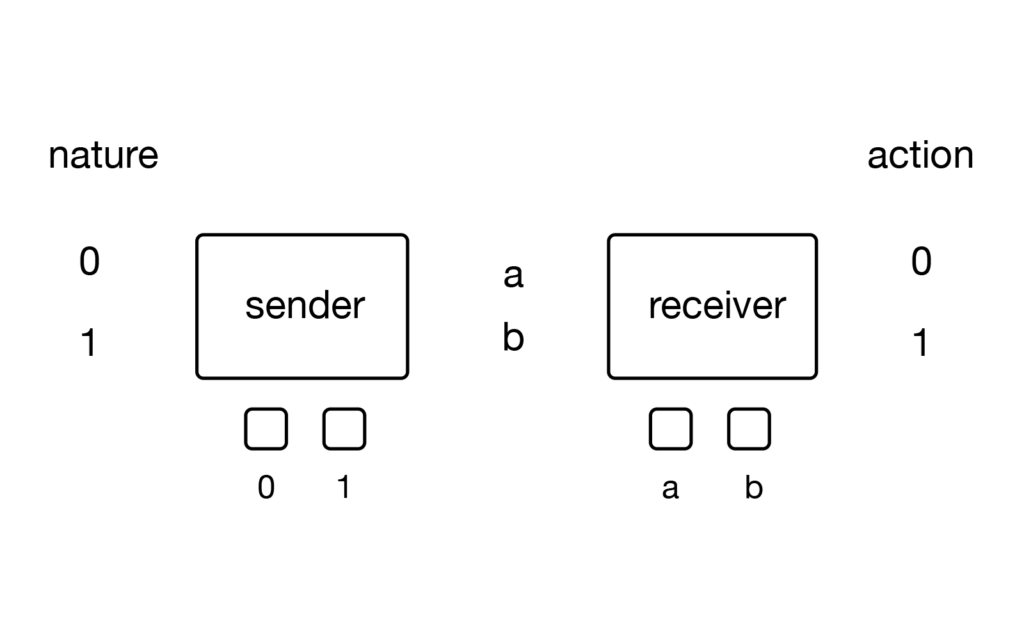
A similarly simple evolutionary process can explain the emergence of meaningful signals in the context of a signaling game. The philosopher David Lewis used signaling games to explain how linguistic conventions might be established without the aid of prior linguistic conventions.1 Brian Skyrms, professor of Logic and Philosophy of Science at UC Irvine, later generalized Lewis’s framework using evolutionary signaling games to show how meaningful language might emerge from random interactions.2 The simplest sort of signaling game involves two players: a sender and a receiver as in figure 1. The sender can see the state of nature and send a signal, but she cannot act. The receiver cannot see the state of nature, but he can see the signal and can act in a way that might benefit both agents depending on the current state of nature. We will suppose that each player learns by simple reinforcement. Simple reinforcement plays the role of an adaptive dynamics in the evolutionary game. How it works can be represented in terms of drawing balls from urns and adding new balls when the agents’ actions are successful.

Figure 1: A Signaling Game. On each play, the state of nature is randomly determined: either  0 or 1. The sender (large box on the left) observes nature, draws a signal, a or b, from her corresponding urn (the two small boxes below her), and sends it. The receiver (large box on the right) sees the signal, draws an action, 0 or 1, from his corresponding urn (the two small boxes below him), and performs it. The receiver’s action is successful if and only if it matches the current state of nature.

On each play of the signaling game, the current state of nature is determined in a random and unbiased way by the toss of a fair coin. The sender has two urns, one for each possible state (0 and 1), and each of these urns starts with two balls, one for each possible signal (a and b). To determine her signal, she observes the state of nature (whether 0 or 1) then draws a signal ball at random from the corresponding urn. Then she sends that signal. She may send a or may send b on a play. Initially, the probability of each is equal as there is one ball of each type in the urn. The receiver has one urn for each possible signal (a and b), and each of these urns starts with one ball for each possible act (0 and 1). The receiver sees the sender’s signal then draws an act ball at random from the corresponding urn. Then he performs the act, whether 0 or 1. The sender and receiver are successful if and only if the receiver’s act matches the current state of nature. In the case of success, each player returns their ball to the urn from which it was drawn and adds a ball of the same type to the urn, thus increasing the probability of this ball being picked again; otherwise, each simply replaces the ball she drew.

This simple type of trial-and-error reinforcement learning is found throughout nature.3 A puppy who finds a scrap of salmon under a picnic table at the park will be more likely to look under that table on future walks. A commuter who gets home easier driving a new route will be more likely to use the new route on future commutes. When an agent learns by simple reinforcement, she may not even reflect on her experience as her dispositions slowly adapt to the world by trial and error. We are using balls and urns to model an adaptive dynamics where the probability of an action increases when the state where that action was successful occurs again.

Consider a concrete example. Suppose state 0 is “it’s sunny,” state 1 is “it’s raining,” signal a is “flash a green light,” signal b is “flash a blue light,” action 0 is “take two straw hats to the picnic” (the right thing to do on a sunny day) and action 1 is “take two umbrellas to the picnic” (the right thing to do on a rainy day). Here the sender wants to send a signal that communicates the weather to the receiver, and the receiver wants to take straw hats if it is sunny and umbrellas if it is raining. But the green and blue signals are meaningless, so there is initially no way to communicate.

On each day it is either sunny or rainy at random and with equal probability. Suppose it is sunny on the first day. The sender sees the sun and draws a ball at random from her corresponding 0 urn. Suppose that she draws a b ball and so flashes a blue light. The receiver sees the flash and draws a ball at random from his corresponding b urn. Suppose he draws a 0 ball, so he takes straw hats to the picnic, the right thing to do on a sunny day. This was a lucky draw since he might have drawn a 1 ball and taken umbrellas. But since he took straw hats on a sunny day, the play is successful, and each player returns the ball she drew to the urn from which it was drawn and adds another ball of the same type to that urn. This makes it more likely in the future that if the sender sees that it is sunny, then she will flash a blue light and more likely that if the receiver sees a blue flash, then he will take straw hats to the picnic. Had the receiver brought umbrellas, the play would have been unsuccessful, and each player would just return their ball to the urn from which it was drawn. In that case, the probabilities of signals and actions would remain the same as they were at the beginning of the day.

It is easy to write a computer program that models two players repeatedly playing this game. On simulation, the sender and receiver initially signal and act at random since each urn starts with one ball of each type and their draws are random. As a result, their signals are initially meaningless. But sometimes the receiver’s random act, by chance, matches the current state and the play is successful. As the players learn by simple reinforcement on what they did when they were successful, their signals gradually evolve meanings that allow the sender to communicate the state of nature reliably and the receiver to do the right thing. Argiento, Pemantle, Skyrms, and Volkov have proven that a perfect signaling language will almost surely eventually emerge in this very simple signaling game.4 And when we run this on a computer, the players typically evolve a reliable signaling language in a few dozen plays. 

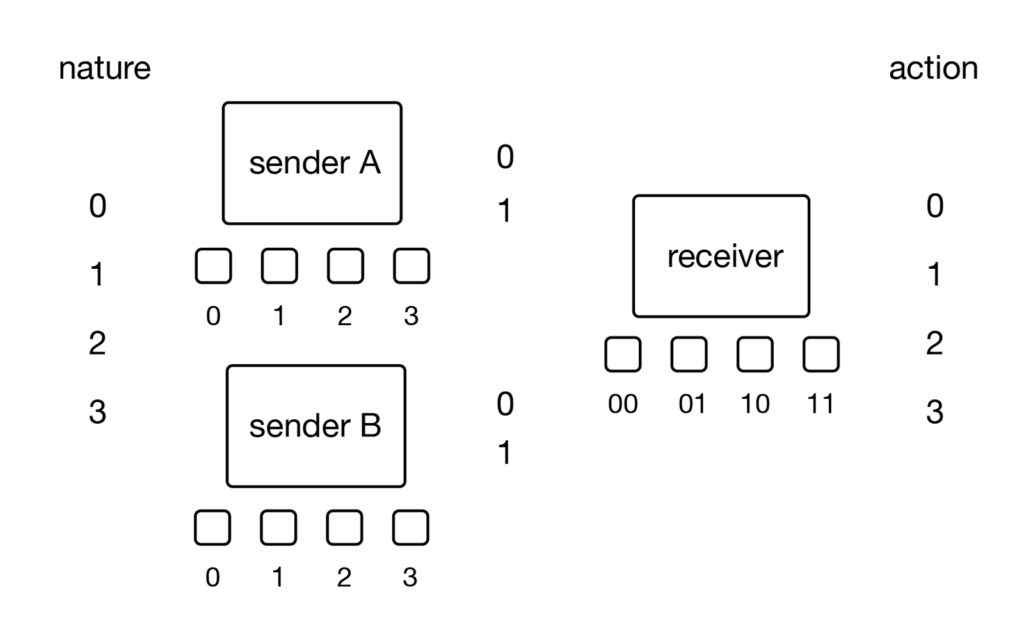
In this simple game, meaningful order emerges from random trial-and-error learning as the behavior of the two players evolves, and each signal ends up communicating precisely one bit of information. Of course, there is nothing in the system that determines up front what the meaning of each signal will be. Their meanings are created by the players as they play. They are the product of random events in the context of the adaptive learning dynamics. A more complicated game illustrates a more subtle type of emergence.5 The coding game involves two senders and one receiver as in figure 2. At the start of each play, nature chooses one of four states, each with equal probability. The two senders observe the state, then each randomly draws a 0 or 1 signal ball from her corresponding urn. The receiver observes both signals and who sent them then draws an act ball from his corresponding urn and performs the action.

Figure 2: The Coding Game. At the start of each play, nature takes one of four states at random. Each of the two senders sees that state then chooses a signal of 0 or 1 from her corresponding urn (the four small boxes below each sender). The receiver sees both signals and draws an action from his corresponding urn (the four small boxes labeled with the two signals he might see). The receiver’s action is successful if and only if it matches the current state of nature.

As in the simple signaling game we considered earlier, a play here is successful if and only if the receiver’s action matches the current state. If so, each player returns their ball to the urn from which it was drawn and adds a ball of the same type; otherwise, each player just returns their ball to the urn from which it was drawn.

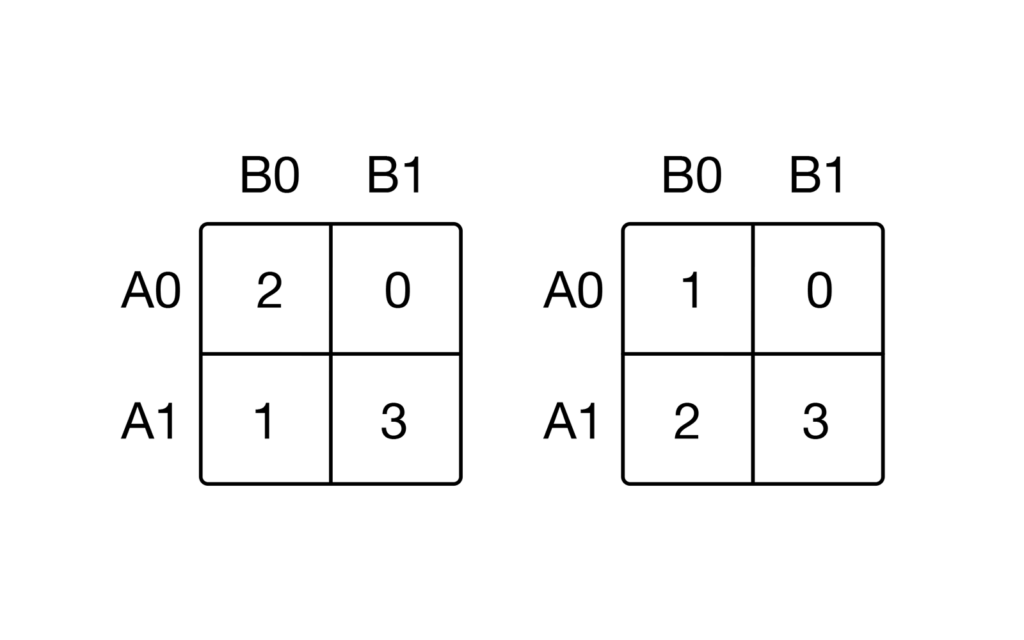
In the coding game, neither sender has the resources required to communicate the state on her own. In order to evolve an optimal language, they must learn to partition nature in a systematic way so that the two signals together fully express which of the four states of nature the sender observes. One way that this might happen is if sender A learns to distinguish between nature being either state 0 or 2 (and sends a 0 if this is true) or state 1 or 3 (and sends a 1 if this is true) and sender B learns to distinguish between nature being either state 1 or 2 (and sends a 0 if this is true) or state 0 or 3 (and sends a 1 if this is true). In this case, 00 would mean state 2, 01 would mean state 0, 10 would mean state 1, and 11 would mean state 3 (see the left hand side of figure 3). This requires each sender to learn to attend to the conventional properties they have jointly invented as they play. When successful, they create and learn to use a systematic code to represent each of the four possible states and actions.

On simulation, the players in the coding game always evolve a meaningful signaling language, but an optimal language evolves in this game only about 73% of the time. When the players are successful in evolving an optimal language, random trial-and-error learning has led to a perfect system for communicating the information required for successful coordinated action. But again, this can only happen when the players create systematically interrelated properties and then attend to whether not each property holds. It is impossible to predict which properties the players will create on a run. Figure 3 shows the properties the players created and learned to track on two different runs. On the first run (on the left), A sends 0 and B sends 0 to represent state 2. But on the second run (on the right), A sends 1 and B sends 0 to represent state 2. The adaptive dynamics allows the players to evolve an optimal language on each run, but the inherent randomness in the dynamics leads to different languages on different runs.

Figure 3: Two codes. The left and right matrices represent perfectly efficient codes the sender and receiver might spontaneously invent on a run of the coding game. The code that emerges in play is randomly determined as the agents learn by trial-and-error reinforcement.

As with the simple signaling game, the coding game illustrates how a meaningful language may emerge in the context of a random, trial-and-error adaptive dynamics. In both games, meaning is created as the players interact with each other and the world. But the coding game also requires the agents to learn to attend to their created properties in the world.

The evolution of attention is the key idea behind large language models like ChatGPT and Claude. The transformer architecture of such models was invented and first described in a paper by a group of Google scientists entitled “Attention is All You Need,” a play on the Beatles’ song “All You Need is Love.”6

A large language model (LLM) is a network with ordered layers of nodes connected by weighted edges. One might picture the network as a set of dots (nodes) and lines (edges) that connect nodes on one layer to nodes on the next layer. Every node is connected to at least one other, and each edge is assigned a numbered weight between 0 and 1 — the larger the number, the stronger the effect of one node on the nodes it is connected to on the next layer. When an input is presented to the input nodes of a trained model, the network produces a random result in the output nodes with probabilities that depend on the weights associated with the edges in the network. The weights are determined by how the model was trained. An LLM is trained using a huge collection of data, a standard of success, and an adaptive dynamics that gradually fits the behavior of the network to the standard of success by a trial-and-error learning process.

As a transformer model is trained, the features of the input to which the model attends and how it behaves when it observes these features, both of which depend on edge weights, are gradually tuned by the adaptive dynamics to fit the actual output of the model to the best possible output given the user-specified standard of success. In this way, as the system evolves, it learns both what to attend to and how to act on what it finds. Later, when it is presented with something it has never seen, it looks in places that have mattered for successful action in the past, then it uses what it sees to produce an output.

One can assess how well a transformer model learns saliences and connections by probing it with inputs that are unlikely to have been used in its training data. Consider the following prompt and Anthropic Claude 3.5 Sonnet’s reply.

*

Prompt: Explain two connections between emergent meaning by means of a random adaptive dynamics and art, complexity, and uncertainty.

Reply: There are several interesting connections between emergent meaning through random adaptive dynamics and the concepts of art, complexity, and uncertainty. Here are two key connections to consider:

Unpredictability and creative emergence:

Both random adaptive dynamics and artistic processes often involve unpredictable outcomes emerging from complex interactions. In adaptive systems, meaning can emerge unexpectedly as elements interact and evolve over time without a predetermined plan. Similarly, in art, the creative process often involves experimentation and allowing unexpected results to emerge. Artists may start with an initial idea but then respond intuitively to how their work develops, embracing uncertainty and complexity. The final artistic product often has emergent qualities that weren’t fully anticipated at the outset. This parallel highlights how both domains harness uncertainty and complexity as generative forces.

Pattern recognition and meaning-making:

Adaptive systems and artistic interpretation both rely heavily on pattern recognition to derive meaning from complexity. In random adaptive dynamics, meaningful structures or behaviors can self-organize out of initially disordered states as the system identifies and amplifies useful patterns. Likewise, both artists and viewers engage in pattern recognition to create and interpret meaning in artworks. Abstract art in particular often presents complex visual information that viewers must actively engage with to discern patterns and construct meaning. This process mirrors how meaning emerges from the complexity of adaptive systems, with the human mind acting as the pattern-recognition mechanism that extracts signal from noise.

*

The prompt asks Claude 3.5 for connections between the themes of the present exhibition and the related themes of this essay. While Claude likely never saw this prompt when it was trained, it does strikingly well in its reply. Strengthening Claude’s reply, I would argue that both artists and viewers are nothing but adaptive systems whose actions are forged by random adaptive processes; but given the inherent uncertainty in its audience, Claude shows wisdom in its more modest position.

Future AI systems will certainly do better, but that Claude has learned to associate a rich collection of topics with the present meager prompt and to thread them together to form cogent, and interesting positions is impressive. Its behavior illustrates how well a simple trial-and-error algorithm can learn to identify natural saliences and to find connections between them if presented with enough data.

While the details are a little different, the emergent behavior of an LLM like Claude is similar to that of the players in the coding game. Each system is initially capable of only random actions. The players in the coding game learn by trial and error to communicate using a meaningful language they gradually create for the purpose. Claude learns by trial and error to identify salient aspects of a prompt then learns patterns in these aspects and how to generate sensible responses. In each case, the adaptive system’s ability to identify saliences and to exploit them for successful action emerges from a trial-and-error adaptive dynamics as it interacts with the world.

Inventing languages, finding saliences, and learning connections involve creativity not unlike that exhibited by an artist. Each of the processes we have considered involves a random element. It is this that makes the process unpredictable.  The players in the coding game must create conventions and learn to adhere to them in order to be successful. It is impossible to predict which conventions they will create. Claude must learn to reply to questions it has never been asked to be successful, and in doing so it may say things that have never been said. And, like the works in the exhibition, its creations may spark new insights.

Our capacities have evolved under trial-and-error natural selection and by means of trial-and-error learning. The inherent randomness of these processes is baked into our nature. It is this that endows us with the ability to create things that are novel and surprising. The present exhibition itself is the product of randomness in the context of an adaptive dynamics. Each artist’s work has been influenced by their noisy experience. The curator has selected works in ways that depend on his experience and interactions with the artists. The resulting collection has the capacity to inspire new insights and understanding in us. The artworks become a part of us, a part of how we act and understand.

Notes

  1. David Lewis, Convention (Harvard University Press, 2020). 
  2. Brian Skyrms “Signals,” Philosophy of Science 75 (5) (2006): 489–500. 
  3. See Richard J. Herrnstein, “On the Law of Effect,” Journal of the Experimental Analysis of Behavior 13 (1970): 243–266, for early work on reinforcement learning in birds. For an example of reinforcement learning in humans, see Alvin E. Roth and Ido Erev, “Learning in Extensive Form Games: Experimental Data and Simple Dynamical Models in the Immediate Term,” Games and Economic Behavior 8 (1995): 164–212.4.
  4. See Raffaele Argiento, Robin Pemantle, Brian Skyrms and Stanislav Volkov, “Learning to Signal: Analysis of a Micro-Level Reinforcement Model,” Stochastic Processes and Their Applications 119, issue 2 (2009): 373–390. The theorem only applies to this two-state, two-term, two-action signaling game with unbiased nature. Convergence is not guaranteed if there are more than two states and acts or if nature is biased. The coding game discussed below is an example of a game where convergence is uncertain.
  5. See Jeffrey A. Barrett, “Dynamic Partitioning and the Conventionality of Kinds,” Philosophy of Science 74 (2007): 527–546, for a discussion of this game.
  6. Ashish Vaswani, Noam Shazeer, Niki Parmar, Jakob Uszkoreit, Llion Jones, Aiden N. Gomez, Łukasz Kaiser and Illia Polosukhin, “Attention is All you Need,” Advances in Neural Information Processing Systems 30 (2017), 31st Conference on Neural Information Processing Systems (NIPS 2017), Long Beach, CA, USA, accessed February 2, 2025.